Time: Popularity:0times
When you see a smooth, even coating on the surface of metal furniture or server racks, it's highly likely the result of electrostatic powder coating. This technology not only enhances the product's appearance but also achieves efficient coating through "electrostatic magic"—but how do powder particles adhere obediently to the workpiece? And how do you avoid the embarrassment of "falling off with a slight vibration"? Today, we'll discuss the "microscopic attraction law" behind electrostatic powder coating.
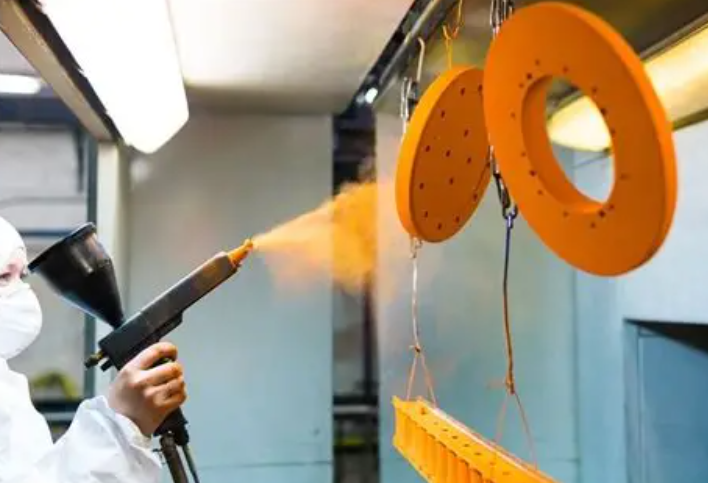
To make powder obediently "stick" to the workpiece, the first step is to give it a stable charge. There are two key indicators here: dielectric constant and resistivity, which can be considered the powder's "electrostatic identity card."
The dielectric constant acts like a "charge preservation box" for the powder: the lower the value, the easier it is for the powder to become charged, but it's also like an unsealed box—the charge moves quickly, and even a slight vibration can cause the powder to "fall off." Conversely, powder with a high dielectric constant, although it charges more slowly, can firmly "lock" the charge onto the particles, maximizing the adsorption force and resulting in a more uniform coating. However, powders with high dielectric constants are somewhat stubborn, requiring a multi-electrode structure in the spray gun for "forced charging" to become properly charged.
Resistivity determines the "charging threshold": when the powder resistivity reaches 10¹³ ohms, a voltage of 30-50kV is sufficient for perfect charging; if the resistivity drops to 10⁸-10⁹ ohms, the voltage needs to be increased to 100-120kV. Experiments have shown that only powders with high resistivity can automatically control the coating thickness—when the powder layer accumulates to a certain extent, a "negative charge shielding layer" forms on the surface, acting like an invisible wall to block subsequent powder, preventing the coating from becoming too thick or sagging.
Once the powder is charged, what "grips" it onto the workpiece? Two main forces are at play: Coulomb force (electrostatic force) and van der Waals force (molecular force).
As polymer compounds (such as epoxy and polyester powders), the powder itself is a "high-resistance insulator," making Coulomb force the primary force—like two magnets, the negatively charged powder is firmly attracted to the grounded workpiece (positive pole). Molecular force acts as an "auxiliary adhesive," relying on the weak intermolecular attraction to make the powder adhere more stably.
However, this process also has its "quirks": if the spraying voltage is too high, an "induced electric field" will quickly form on the workpiece surface, causing the negative charge density to surge, pushing subsequent powder away before it even gets close, resulting in a thin and uneven coating. Conversely, appropriately reducing the voltage can slow down the powder transfer speed, reduce repulsion and rebound, and actually increase powder application efficiency—this is why the voltage needs to be lowered for re-sprayed parts (those with an existing old coating).
You might wonder: Where does the powder's charge come from? The answer is corona discharge—the electrode needle at the tip of the spray gun releases high-voltage static electricity, ionizing the surrounding air and creating an "electron avalanche": electrons are accelerated by the strong electric field, colliding with air molecules to produce more ions, ultimately turning the gas molecules into negatively charged "ionized ions."
When powder passes through this "ion cloud," it's like it's covered in "static hooks"—but these hooks aren't randomly attached: only when the powder surface has "positively charged impurities" or "potential pits" can the negative ions be precisely adsorbed. Furthermore, the powder surface has high resistance, so the charge doesn't wander randomly, meaning the charge distribution of each particle is actually uneven, but this actually makes the adsorption tighter.
Even the best process can't withstand powder "deterioration"—powder stability directly affects the coating effect: improper storage can cause powder to clump, reduce leveling properties, compromise the charging effect, and even result in defects such as pinholes and decreased gloss.
How to determine powder stability? In the industry, "accelerated aging tests" are conducted: powder is stored at 30°C or 40°C for several days to weeks to observe changes in its leveling properties. If the powder undergoes a violent cross-linking reaction, its molecular weight increases, and its viscosity skyrockets during curing, resulting in a rough coating. Therefore, when preparing powder samples, it's crucial to first test its stability; nobody wants to use "spoiled" powder to spray workpieces.
In actual production, the most troublesome issue is "re-coated parts"—workpieces with an existing old coating. In this case, the resistivity is higher, making it harder for the charge to dissipate. If the original voltage is used for spraying, the new powder will be "repelled" by the negative charge of the old coating, causing a sharp drop in powder application rate.
The secret in this situation is "reducing voltage and controlling speed": lowering the voltage reduces the powder's charge and transfer speed, avoiding strong repulsion; simultaneously, adjusting the spray gun distance allows the powder to "gently" approach the workpiece, improving application efficiency and ensuring a uniform coating over the old film.
Electrostatic powder coating is like a precise "microscopic collaboration": the dielectric constant and resistivity determine the powder's "electrostatic properties," corona discharge is the factory that "hooks" the powder, Coulomb force and molecular force are responsible for "hooking and sticking," and stability is the "safety net" that ensures the effect. From charging to adsorption, from thickness control to back-spray adjustment, every step is an "art of balance"—ensuring the powder is properly charged while avoiding repulsion; ensuring adsorption while controlling coating thickness.
Today, this technology not only makes coatings more durable and environmentally friendly (powder utilization rate exceeding 95%), but also enables 24-hour continuous production through automation. Next time you touch a smooth metal coating, consider how many subtle electrostatic, mechanical, and materials science considerations are hidden behind this "protective film."



Company Phone
+86-21-6420 0566
Working hours
Monday to Friday
Mobile phone:
13816217984
Email:
info@qinsun-lab.com